41 per stirpes vs per capita diagram
A Google User. Peter is a model attorney who puts his clients first at all costs. His extensive expertise in estate planning and tax planning was a great comfort as we began, and have expanded, our family. With regard to grandchildren, a Per Stirpes distribution often has the same result as a Per Capita with Representation distribution. In our example, a Per Stirpes distribution would leave $300,000 to Child Y and another $300,000 to Grandchild Z1. The children of Child X,
Text in this Example: ESTATE PLANNING PER STIRPES vs. PER CAPITA Per Stirpes Distribution Example Per Capita Distribution Example Generational Line Weighs each person equally System of inheritance under which each person of the deceased person's family receives an equal share of the estate Weighs each branch equally System of inheritance under which each branch of the deceased person's family ...
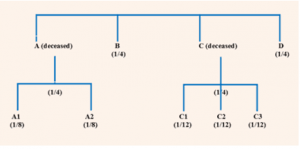
Per stirpes vs per capita diagram
Per stirpes vs per capita. Per stirpes and per capita are two different ways of distributing a deceased person's inheritance if one (or more) of the beneficiaries in their will predeceased them. If someone's beneficiary predeceases them, the per capita method would result in the deceased beneficiary's share being returned to the estate and ... Per Capita Distribution. Now, let's look at what happens when assets pass under a Per Capita distribution system, rather than Per Stirpes. Under Per Capita, things are going to pass a little differently. With Per Capita, we're actually looking at each generation and we're going to split it equally. Under this scenario, if the decedent ... Per Stirpes vs. Pro Rata. This is where our Latin lesson comes into play. When you name multiple beneficiaries (or multiple contingent beneficiaries), as this client did, there's always the chance that one or more of those beneficiaries will die before you do. If that happens, the language in your IRA agreement will specify what happens next.
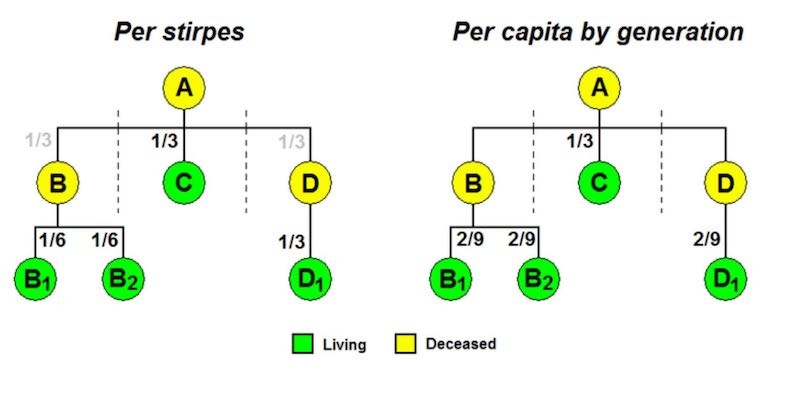
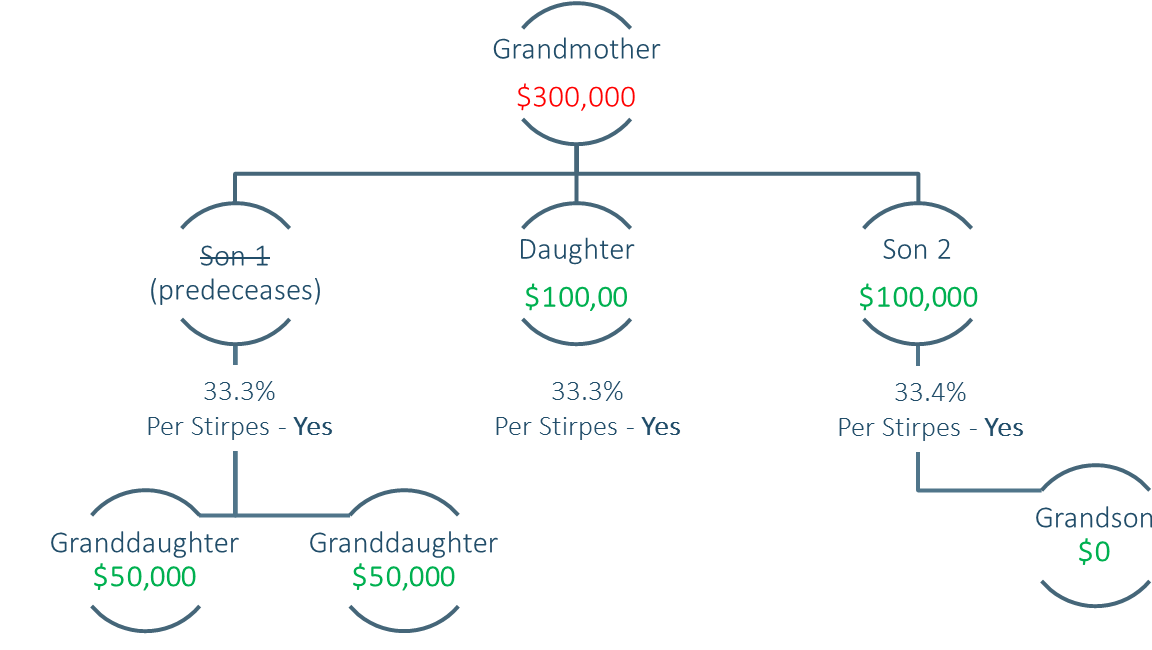
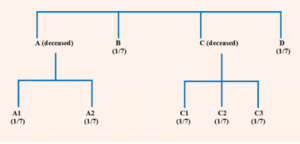
Per stirpes vs per capita diagram. Another version of per stirpes would give equal shares to each beneficiary of the same generation, whether or not there are other beneficiaries at different generations. In the first diagram, this would mean that the living child receives one-third of the estate, and the five grandchildren would each receive one-fifth of the two-thirds ... BY RIGHT OF REPRESENTATION (aka PER STIRPES DISTRIBUTION) A distribution of property that passes such that any property that would otherwise pass to a predeceased heir or beneficiary is distributed instead to his/her then living issue, equally if in the same generation. Contrast: PER CAPITA DISTRIBUTION. Distributing per stirpes means the proceeds are to be divided by branch of the family, while per capita means it's to be divided by head. Here's how it all works: Karen has two adult children, John and Molly, names as beneficiaries on her life insurance policy. John has three children and Molly has one. An example of per stirpes and per capita in action. Assume that Bob is a widower and has two children, Jack and Michelle, whom he chooses to be the primary beneficiaries on his IRA, with a 50/50 split. Jack has two children, while Michelle has none. At the time of Bob's death, his IRA is worth one million dollars, and Jack has already passed ...
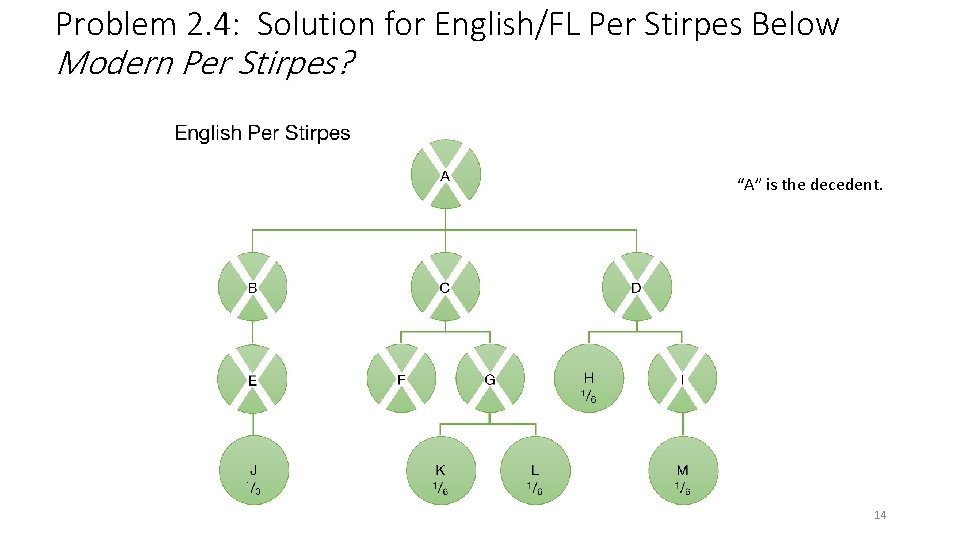
Why Per Stirpes Remains Popular. Per capita and per capita at each generation provide testators with greater options. Per stirpes, however, remains by far the most common of the three. It simply reflects what many people consider to be the natural course of things. Per stirpes follows the assumption that children will inherit equally from their parents. per stirpes. Per Capita and Per Stirpes When the intestate's children, or brothers, sisters, uncles, or aunts or any other relative standing in the first or same degree alone come into distribution upon intestacy, they shall take per capita, namely, by persons. If a part are living and a part are dead, the The per capita with representation (aka modern per stirpes, American per stirpes) works exactly like the strict per stirpes approach, except that the estate is divided equally at the tier that has a live taker. The estate is then divided by the number of lines of descent at that tier. Scenarios applying per stirpes: . In the above diagram, under a traditional per stirpes approach, once both Jane and Joe are deceased, their estate will get split 3 ways between Anna, Bruno and Charo. Easy enough. But if Bruno dies and he has no children, then his 1/3 goes back into the estate and the estate is split ½ to Anna and ½ to Charo.
"Per Stirpes" and "Per Capita" Explained . By Brian Madigan LL.B. (President: Ontario Real Estate Source) The latin expressions "per stirpes" and "per capita" literally can be translated as "by roots" or "by heads".They are used extensively in Wills and Trusts, so their meanings must be properly understood. A Per Capita distribution differs from Per Stirpes. In a Per Capita distribution, your property is divided equally among all of your surviving descendants. You, as the estate owner, can name each beneficiary individually, or specify which group of your descendants (children, grandchildren, or both for example) will receive your assets. Per stirpes is sometimes called "by right of representation" because the descendants of a deceased heir will inherit that heir's share. Per Capita. In contrast, per capita means assets pass equally to the heirs who are living at the time of the death of the testator at the level stated. Let's use the same example we reviewed above. The Latin term per stirpes is commonly used in estate planning to describe how a person making a will would like his assets to be distributed. In case a family beneficiary dies before the will's owner, a per stirpes distribution means that person's portion of the assets go directly to that beneficiary's heirs. There are other options if the will's owner (called a "testator") does ...
Per Stirpesâ€, “By Representationâ€, “Per Capitaâ€-What Do They ...
OUR LEGAL HERITAGE King AEthelbert - King George III, 1776 600 A.D. - 1776 By S. A. Reilly, Attorney 175 E. Delaware Place Chicago, Illinois 60611-7715 *.*.******@***.*** 5th Edition Copyright (C) 2004 Preface This was written to appreciate what laws have been in existence for a long time and therefore have proven their success... The Project Gutenberg EBook of Our Legal Heritage, 5th Ed., by S. A. Reilly This eBook is for the use of...

How Inheritance Gets Complex When Children Predecease Parents ...
Per Stirpes Vs Per Capita Diagram. Per stirpes is a legal term from Latin. An estate of a decedent is distributed per stirpes if each branch of the family. *This is a common example of how per capita versus per stirpes would work. Be sure to understand how the institution holding the asset handles per capita.

Chapter 17 Transferring Real Estate after Death: Wills ...
Per Stirpes Vs Per Capita Diagram Per stirpes is a legal term from Latin. An estate of a decedent is distributed per stirpes if each branch of the family. *This is a common example of how per capita versus per stirpes would work. Be sure to understand how the institution holding the asset handles per capita.

Boilerplate and Default Rules in Wills Law: An Empirical ...
3. The division in representation, where division is per stirpes - the representative divide only the share pertaining to the person represented. Note: The share of an illegitimate child is ½ of the share of a legitimate one. Full blood brother or sister is entitled to double the share of half brother or sister (Art. 1006).

Per capita, per stirpes | The Legal Genealogist
Per stirpes and per capita are two terms commonly used in wills and living trusts to guide the distribution of property. The difference between per stirpes and per capita is that beneficiaries closest to the deceased receive an equal share of the estate in a per stirpes division while per capita is divided equally among all living descendants.

Per stirpes and per capita distributions in deceased estates -
0. Traditionally, estates have been passed down by per stirpes descent. More recently, this system has been replaced by the per capita by each generation system. Only an estate planning attorney can love and understand these terms. Under the per stirpes approach, which is Latin for "by the roots," estate assets are passed down by family group.

Shiotani & Inouye - Attorneys at Law: News: Social Media Policies
Search Search en Change Language Upload Read free for 30 days User Settings Skip carousel What is Scribd? Ebooks Audiobooks Magazines Podcasts Sheet Music Documents (selected) Snapshots 0 ratings0% found this document useful (0 votes) 4K views 5,916 pages Words Uploaded byJosh Edgcomb Description:A bunch of words. Aardvark....

per stirpes – From the Law Office of Sylvie L. F. Richards, PLLC
Designating Beneficiaries Using Per Capita. Using the per capita designation is an easier concept than per stirpes. Basically, per capita divides an asset equally among a specified group of beneficiaries. So, if a primary beneficiary predeceases you, the asset will pass to each remaining beneficiary in equal shares.

Beneficiary Designations: Per Stirpes and Per Capita - BWM ...
per stirpes: [adverb or adjective] in equal shares to each member of a specified class with the share of a deceased member divided proportionately among his or her beneficiaries (such as children).

Yates Campbell & Hoeg LLP When children & grandchildren ...
Per stirpes is a legal term that describes how your assets are divided and distributed. In Latin, per stirpes simply means "by branch." If you choose to distribute assets to your children first, but then to their children should they pass away before you do, you have in essence set up your Will or Trust per stirpes.. Read on for everything you need to know about how per stirpes works in ...

Yates Campbell & Hoeg LLP When children & grandchildren ...
To use per stirpes correctly, you just have to follow one rule: Always make the gift to a person's descendants, like "to [person's] descendants, per stirpes." Note a couple of things: (1) in general, the person should be one person, not a class of people; and (2) the word "descendants" (or "issue") must always appear.

Intestate Distribution to Ancestors and Collateral Relatives ...
Note in the consanguinity diagram that all relatives depicted in the same color have the same degree of relationship (depicted in red numbers) ... Many states also use the per stirpes/per capita with representation/per capita at each generation intestate distribution schemes within the parentelic lines with live takers.
2 More Basic Trust Concepts
In this post, I discuss the per stirpes manner of inheritance distribution. For more detailed information, please see my book, The Simple Guide to Estate Planning: A Look at Wills, Trusts, and Taxes. Photo by Joe Campbell is licensed under CC BY-SA 2.0.. This content uses referral links. Estimated Reading Time: 4 minutes. If you've ever read through a will, you have likely encountered the ...
Trusts Estates Essentials Power Point Slides Class 5
Per Stirpes vs. Pro Rata. This is where our Latin lesson comes into play. When you name multiple beneficiaries (or multiple contingent beneficiaries), as this client did, there's always the chance that one or more of those beneficiaries will die before you do. If that happens, the language in your IRA agreement will specify what happens next.
How is the per capita income during Neoliberalism? - Quora
Per Capita Distribution. Now, let's look at what happens when assets pass under a Per Capita distribution system, rather than Per Stirpes. Under Per Capita, things are going to pass a little differently. With Per Capita, we're actually looking at each generation and we're going to split it equally. Under this scenario, if the decedent ...

Per Stirpes†vs. “Per Capita†vs. “By Representation†What ...
Per stirpes vs per capita. Per stirpes and per capita are two different ways of distributing a deceased person's inheritance if one (or more) of the beneficiaries in their will predeceased them. If someone's beneficiary predeceases them, the per capita method would result in the deceased beneficiary's share being returned to the estate and ...

per stirpes – From the Law Office of Sylvie L. F. Richards, PLLC

per stirpes | Ask Harry
Trusts Estates Essentials Power Point Slides Class 4

Naming Beneficiaries - A Key Ingredient — Mallard Advisors
Basic Arkansas Intestate Succession, Rights of Surviving ...

Per Stirpes vs Per Capita: Difference, Similarities, How it Works

Distribution of Giardia lamblia assemblages (circles ...

Contingent Beneficiary - Per Stirpes vs. Per Capita - Brandon ...

Beneficiary Designations: Per Capita or Per Stirpes ...

Dying Without A Will: A Guide To The Distribution of Your ...

Per Stirpes Vs. Per Capita Retirement Beneficiaries | Seeking ...

Per stirpes - Wikipedia

TERMS AND DEFINITIONS - Executor Guide for British Columbia

Per Stirpes v Per Capita

TEXAS INTESTATE DISTRIBUTION OF REAL PROPERTY Philip C
The Difference Between Per Stirpes, Per Capita and By ...

Becoming an Heir by Right of Representation in a Washington ...

Per capita financial definition of per capita

Per Capita & Per Stirpes Beneficiaries Defined | Farmington CT
Should I Check the Per Stirpes Box? - Porter White Co.
Per Stirpesâ€, “By Representationâ€, “Per Capitaâ€-What Do They ...

Wills, Trusts and Estate Planning - ppt video online download

Wills, Trusts and Estate Planning - ppt video online download

Yates Campbell & Hoeg LLP When children & grandchildren ...

Per stirpes


Comments
Post a Comment